
Regional Security
What we are tracking
Saudi Arabia, Pakistan, and Turkey triggered their Mecca mutual defence pact for the first time on October 5, the Financial Times reported. The pact, signed in August, treats an attack on one member as an attack on all. The decision, aimed at the “rapid deployment” of Pakistani and Turkish forces and capabilities to the kingdom, followed an emergency meeting in Riyadh in response to attacks by Iran-backed groups. Turkey’s parliament has not yet ratified the pact, however, making a Turkish ground deployment unlikely for now. The same day, Saudi and Yemeni forces launched a counteroffensive to retake the port of Mocha and secure the Bab al-Mandeb. Around 100 jet fighters provided air cover, the Wall Street Journal reported, and coalition naval forces struck Houthi depots holding explosive-laden boats and naval mines in Hodeidah. A government-linked news agency said forces had recaptured Mocha, though rival claims could not be independently confirmed. The Houthis responded with missile and drone attacks across Saudi Arabia and warned international airlines to avoid Saudi airspace. Saudi authorities said strikes damaged airports in Jazan and Najran, causing three minor injuries. Secretary of State Marco Rubio said Saudi Arabia has “a right to defend themselves,” while U.S. support remains limited to intelligence and indirect assistance.
Why it matters
Yemen has become the most active battlefield in the wider conflict with Iran, with control of a vital energy chokepoint at stake. Triggering the Mecca pact gives Riyadh a multilateral framework for support at a moment when Washington has declined to join air strikes. But the Houthis have pledged “escalation for escalation” and are extending the threat to civil aviation, just as the region enters its peak travel season.
What to watch
Whether coalition forces hold Mocha and secure the Bab al-Mandeb; what Pakistani and Turkish capabilities are deployed and whether Turkey ratifies the pact; and whether international carriers reroute or suspend flights over Saudi airspace.
Aviation Security
What we are tracking
Investigations are under way in the UAE, Israel, and Oman following an in-flight attack on FlyDubai Flight 1073 from Dubai to Tel Aviv, in which the co-pilot assaulted the captain. The captain and a group of passengers subdued the co-pilot and recovered the aircraft, preventing a fatal outcome. The UAE’s attorney general has said the co-pilot attempted an act of terrorism. Investigators have not found links to any foreign power or major terrorist organization. The Wall Street Journal reported that officials in all three countries have privately acknowledged significant gaps in pilot vetting, information-sharing, and crew screening. UAE authorities are reviewing the hiring process, Israeli Prime Minister Benjamin Netanyahu has ordered a review of security for foreign airline flights to Israel, and FlyDubai has suspended flights to and from Israel while the investigation continues.
Why it matters
The incident highlights a structural challenge in aviation security: concerns about individuals often stay with national authorities and are not shared across borders, even as airlines hire rapidly to meet strong global pilot demand. Security experts quoted by the WSJ argue the priority is intelligence-sharing that identifies threats long before they reach the airport. The incident also comes at a sensitive moment for traveller confidence in the region.
What to watch
The findings of the investigations in the UAE, Israel, and Oman; whether Gulf states move toward more formal information-sharing on aviation security.
Tourism and Real Estate
What we are tracking
Global hotel operators expect early signs of recovery in the Middle East as peak travel season begins, though performance remains well below pre-war levels, Bloomberg reported. Analysts estimate Marriott’s and Hilton’s regional revenue per available room will rise about 70 and 65 percent respectively in the fourth quarter from the second. Even so, STR expects revenue per room across Dubai, Abu Dhabi, Jeddah, and Riyadh to be 30 percent lower than a year earlier, with a return to 2025 levels not expected until 2028. Domestic and intra-regional travel, particularly in Saudi Arabia, has cushioned the decline. The return of foreign carriers is seen as key, with Lufthansa resuming Dubai flights in late October and British Airways in November. Operators are not pulling back on long-term plans: Accor plans 47 new hotels in Saudi Arabia and IHG plans 62. Gulf capital is also building tourism beyond the region. The FT reported that Abu Dhabi and Qatari sovereign funds and Emaar are investing billions in Egypt’s Mediterranean north coast. Those projects include Abu Dhabi’s $35 billion Ras el-Hekma development and Qatari Diar’s $30 billion Alam al-Roum project. At Emaar’s Marassi resort, 65 percent of hotel occupancy in late August was non-Egyptian, almost entirely from the Gulf.
Why it matters
The recovery is real but slow. “There has been a recovery, but it’s not a V-shaped recovery,” said McKinsey’s Margaux Constantin. The fourth-quarter calendar will be an important test, including Formula One races in Doha and Abu Dhabi, the Guggenheim Abu Dhabi opening in December, and Abu Dhabi Finance Week. Meanwhile, Gulf investment in Egypt’s north coast shows regional capital building destinations beyond the Gulf, with Gulf travellers already among their most valuable visitors.
What to watch
Whether foreign airline resumptions hold as the Houthi threat to Saudi airspace grows; how fourth-quarter event attendance tracks against forecasts; and whether Egypt’s north coast projects can extend beyond the summer season to become year-round international destinations.
Energy and Food Security
What we are tracking
Saudi Aramco chief executive Amin Nasser warned that global oil stockpiles are now “scarily thin,” the Financial Times reported. Nasser said the war has removed nearly 3 billion barrels of supply from the region, and more than 1 billion barrels have been drawn from reserves to cushion the shortfall. He estimated that less than 6 billion barrels of commercial inventories remain, most of them not practically available. Even after the conflict ends, he said, rebuilding inventories could take up to two years. Aramco is studying additional export routes and further overseas storage to protect customers from future disruptions. Gulf shipments recovered to 15.5 million barrels a day in September, more than 80 percent of pre-war volumes, according to Kpler, but at high cost. Separately, International Chamber of Commerce secretary-general John Denton warned the Wall Street Journal that a global food crisis is building. About one-third of global fertilizer shipments pass through Hormuz, and available fertilizer capacity has fallen by nearly 40 percent since the strait was disrupted. Denton estimated cereal prices could rise by up to 80 percent if there is no progress. A UN-backed framework to temporarily place the strait under international governance remains stalled pending a U.S.-Iran agreement.
Why it matters
The war’s economic impact is spreading from energy into food. Denton called fertilizer “the story which is the killer,” with developing economies such as the Philippines, which imports roughly 90 percent of its fertilizer, most exposed. With buffers depleted, the system has little capacity to absorb further shocks.
What to watch
Whether governments coordinate further strategic reserve releases; how fertilizer shortages feed into harvest and food prices over the coming season; and whether the UN-backed governance mechanism for Hormuz gains traction.
Infrastructure and Trade
What we are tracking
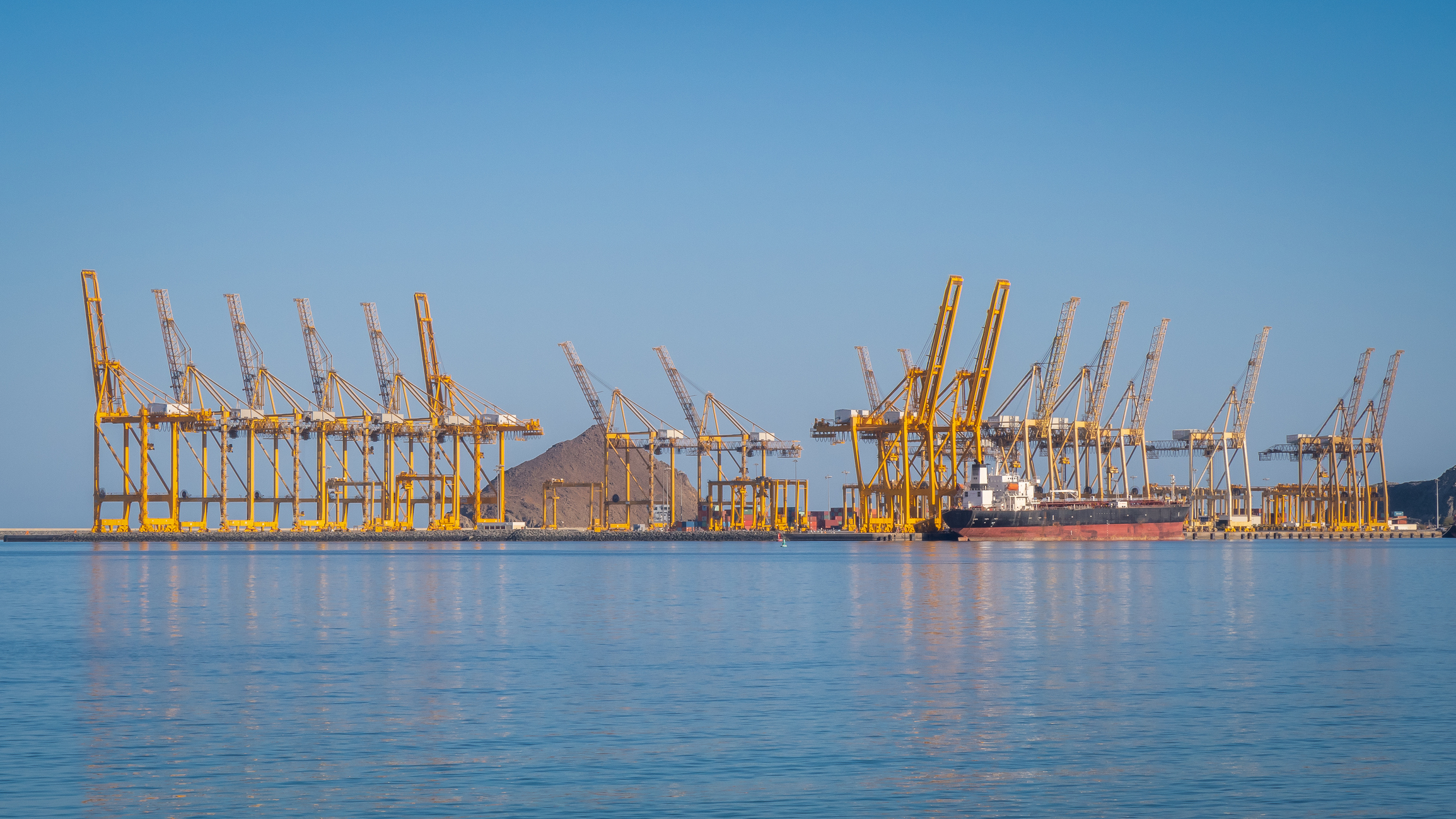
Abu Dhabi Crown Prince Sheikh Khaled bin Mohamed is emerging as a central figure in the UAE’s “Zero Hormuz” strategy, Bloomberg reported. The strategy aims to end the country’s dependence on the strait whether or not it reopens. L’imad Holding, the $300 billion wealth fund he chairs, announced plans to take Abu Dhabi Ports private at a nearly $9 billion valuation. People familiar with the matter say the fund is likely to spend tens of billions of dollars more on new port infrastructure outside the strait, with a focus on Fujairah. In May, L’imad joined BlackRock’s Global Infrastructure Partners, Temasek, and ADNOC in a partnership targeting up to $30 billion in energy transport, logistics, and water infrastructure. As chair of ADNOC’s executive committee, Sheikh Khaled also directed the company to accelerate a second pipeline that will double export capacity through Fujairah. Dubai’s DP World is separately building new container terminals in the same area.
Why it matters
The UAE has an advantage over Qatar, which has no geographic route around the strait. Bringing in global partners such as BlackRock means the buildout is not solely state funded. The risks remain significant: Fujairah was hit by debris from an intercepted drone in March, and analysts note the UAE’s eastern ports remain within range of drones and short-range missiles. “The UAE needs to prepare for infrastructure targeting out of Hormuz as well,” said Sanam Vakil of Chatham House.
What to watch
The scale and timing of L’imad’s port investments in Fujairah; whether the $30 billion infrastructure partnership announces its first projects; and how Abu Dhabi and Dubai coordinate the expansion of a crowded port area.
Capital and Investment
What we are tracking
Middle East and North African investors have deployed $102 billion so far this year and are on track for $136 billion, their second-highest year of dealmaking on record, according to Global SWF data cited by Bloomberg. Mubadala was again the most prolific spender at $26.2 billion, including capital deployed by MGX, while L’imad deployed nearly $11 billion. That momentum continued this week. OpenAI is in talks with a syndicate of UAE funds, including MGX, which has discussed investing as much as $10 billion in a $30 billion round at a valuation of about $1.4 trillion. BlackRock is also in discussions to participate. Global firms are also expanding into the region. Singapore’s $401 billion Temasek will open its first Middle East offices in Riyadh and Abu Dhabi in the first half of 2027, saying the region’s “long-term fundamentals remain highly attractive.” EQT and Eurazeo have also announced Abu Dhabi offices. The pace comes despite fiscal pressure in parts of the region. Saudi Arabia now projects a deficit of 4.9 percent of GDP this year and a 3.6 percent contraction, followed by a sharp rebound in 2027. Qatar’s deficit has reached a decade high, and Kuwait now allows borrowing from its Future Generations Fund. The UAE’s federal budget is projected to remain balanced.
Why it matters
Gulf capital has not retreated during the war, and global firms are responding by moving closer to it. The open question, as Bloomberg put it, is whether Gulf wealth funds can keep playing banker to the world when their own governments may need them as financiers at home. That tension could make deployment more selective, with strategic and domestic priorities weighted more heavily.
What to watch
Whether the UAE syndicate anchors OpenAI’s round; whether more global managers follow Temasek, EQT, and Eurazeo into the region; and whether fiscal pressures slow sovereign deployment in 2027.
Diplomacy
What we are tracking
A Premier League ruling against Abu Dhabi-owned Manchester City has tested UK-UAE relations ahead of a bilateral investment summit in London later this month, Bloomberg reported. An independent commission found the club guilty of all but one of 115 charges, with sanctions yet to be set. The club has appealed and maintains it is innocent. The UAE has invested more than £30 billion in the UK over the past five years across defence, life sciences, and technology, well above the £10 billion Mubadala committed under the 2021 investment partnership. According to Bloomberg, Emirati officials have warned that the severity of the ruling could affect their appetite for future large-scale UK commitments, while UK officials have also expressed frustration. Prime Minister Andy Burnham thanked the club’s owners for their investment in Manchester, a comment that drew criticism within his government, and Downing Street later said the club is not “above the rules.” Club chairman Khaldoon Al Mubarak, who also leads Mubadala, met Business Secretary Jonathan Reynolds on September 14 in his Mubadala capacity.
Why it matters
The episode shows how a sporting dispute can spill into a strategic relationship. Both sides agree that defence cooperation, which has grown more important during the Iran war, matters far more than football. The upcoming investment summit will show whether the partnership can be insulated from the ruling.
What to watch
The outcome of the club’s appeal and any sanctions; whether the London investment summit produces new UAE commitments; and how both governments manage the issue in public.
Strategy and Outlook
What we are tracking
Writing in Foreign Affairs, Alan Boswell of the International Crisis Group argues that the conflicts in the Middle East and the Horn of Africa have become inseparable, forming a single security sphere around the Red Sea. He writes that the Iran war has widened existing differences between Saudi Arabia and the UAE, weakened the U.S.-anchored security order, and raised the stakes of securing the Red Sea, through which Riyadh now diverts most of its oil exports. Saudi Arabia has extended its alignment with Egypt, Turkey, and Pakistan into the Horn, including a defence agreement with Somalia earlier this year. The UAE has deepened security partnerships with the U.S. and Israel and maintains infrastructure at Berbera in Somaliland and Bosaso in Puntland. Boswell warns that renewed fighting in Ethiopia’s Tigray region could trigger an Ethiopia-Eritrea war that merges with the conflict in Sudan.
Why it matters
With Hormuz constrained, the Red Sea is central to Gulf energy security, and instability on its African shore now feeds directly into Gulf calculations. Boswell argues that coordination between Riyadh and Abu Dhabi to de-escalate conflicts in the Horn is the clearest way to prevent a wider regional war.
What to watch
Whether fighting in Tigray spreads toward the Eritrean border; whether Saudi Arabia and the UAE find common ground on de-escalation in the Horn; and how reported Houthi inroads into Somalia affect shipping in the Gulf of Aden.
Related articles
- Saudi-Backed Forces Launch Fight to Free Bab al-Mandeb From Houthis (Wall Street Journal)
- Yemen’s Houthi Rebels Strike Two Airports in Saudi Arabia (Wall Street Journal)
- The New Red Sea Wars (Foreign Affairs)
- OpenAI in Talks With UAE Funds, BlackRock for $30 Billion Funding Round (Bloomberg)
- Marriott, Hilton Eye Middle East Recovery as Peak Season Nears (Bloomberg)
- Gulf Developers Bet on the Next Mediterranean Destination (Financial Times)
- Multiple Security Failures Allowed FlyDubai Pilot Into Cockpit (Wall Street Journal)
- Saudi Arabia, Pakistan and Turkey Trigger Mutual Defence Pact (Financial Times)
- Hormuz Gridlock Risks Global Food Crisis, International Chamber of Commerce Chief Says (Wall Street Journal)
- Prince Is Spending Billions to Bypass Iran’s Grip on Hormuz (Bloomberg)
- Bankers to the World Are Keeping the Cash Flowing Despite War (Bloomberg)
- Manchester City Verdict Strains UK-UAE Diplomatic Relations (Bloomberg)